This interactive infographic from the New York Times shows the growth of U.S. wineries from 1937 until now.
http://www.nytimes.com/interactive/2013/07/07/business/a-nation-of-wineries.html?_r=0
Here's an excerpt from the section about Texas:
(click to see it larger)
Wine education, wine cheat sheets, travel, and geeky infographics.
Based in the Houston/Clear Lake area.
Twitter: @ClearLakeWine | pinterest.com/clearlakewine
Tuesday, July 9, 2013
Wednesday, July 3, 2013
Texas Saké (a surprise addition to your 4th of July?)
Did you know Texas makes saké? I didn’t until recently. And it’s not just any sake: it’s saké made from the same type of rice
used in Japan, it’s organic, and it’s good.
I don’t typically like saké very much, so I’m not a connoisseur, but I
do know that the fresh, crisp, grassy, earthy, and slightly sweet notes in this
saké made it better than almost any I’ve had.
And I’m always excited to promote organic and Texas-made products.
I learned about the Texas Saké Company a couple of weeks ago
when I attended the opening of an art exhibition at the Asia Society. The evening had a Japanese theme, so the
Texas Saké Company was there offering samples.
I learned that Texas is rare because it is one of only “a few areas
outside of Japan that grow the right type of rice to make sake.” Apparently this type of rice was brought to
Texas in the early 1900s and grows here so well that from then until now, most
of the rice grown in Texas has been Japanese rice. The Texas Saké Company in Austin uses
“centuries-old handcrafted techniques” to create its saké in small batches
that are certified organic. They are
producing the “first and only saké made from Texas rice.”
It comes in 2 types.
“Whooping Crane” is a traditional saké. (That's the one in the picture, which I borrowed from their web site, and hopefully they won't mind!) “Rising Star” is a coarsely filtered sake, which is cloudy and has a
creamier mouth-feel. They are available
at Central Market, Whole Foods, and Houston Wine Merchant. Both types cost roughly $22 for a 375ml
bottle, and $35 for 750ml.
If you like saké, or maybe even if you think you don’t, I
encourage you to give these a try. They
would be a nice accompaniment if you're grilling chicken or fish on July
4. Make sure you chill them! And if you’re in the Austin area, stop by and
visit – the tasting room is open every Saturday.
Monday, July 1, 2013
Retsina Update
Recently I wrote about ancient beers and wines, including retsina, the Greek white wine infused with pine resin. Unfortunately, though retsina is fascinating, it isn't that pleasing to drink, and it's a shame to waste wine (no matter how cheap). At the time I speculated that it might make a good cooking wine, and I'm here to report that I tested that theory.
I made a simple chicken stew in the crockpot with chicken breasts, onion, garlic, carrots, celery, kale, and white beans. I flavored it with salt, pepper, and rosemary, and used a combination of chicken broth and retsina for the cooking liquid. It turned out great. Since the pine flavor in the wine is reminiscent of rosemary, the retsina just punched up that flavor. I think you could use retsina in any dish where you would normally add white wine and rosemary.
Now you have no excuse not to try this wine that's been around for 2000 years. Taste it, let it transport you back in time, then cook some chicken in it.
Friday, June 28, 2013
Boxed Wine?
Really?
Yes! There are plenty of reasons you might want to buy boxed wine.
- It’s cheap.
- It’s environmentally friendly (less packaging and less weight to ship).
- The bottle can’t break.
- It can’t have cork taint.
- It’s portable – you can take it to the beach or any other place that doesn’t allow glass.
- It will stay fresh for WEEKS! Maybe more!
When I say boxed wine, I mean the bag-in-a-box type. Some wines are sold in “Tetra Paks” which are
basically cardboard, and can do all of the things listed above except the last
one – stay fresh for weeks. That’s
because the bag-in-box design keeps the wine away from oxygen as you use it,
while a Tetra Pak doesn’t. Bag-in-box
designs have a spigot, while Tetra Paks usually have a small plastic screw cap
on the top.
But will it taste good?
Box wines have a bad reputation, but in recent years they’ve
been improving. Here are some to try,
based partly on my experience and partly on tasting panels that have posted
reviews. These are the recommended brands that are
available in our area. They come in 3
liter boxes, which are equivalent to 4 bottles:
- Osbourne Bodegas Seven Red Table Wine - $17
- Bota Box (especially the Shiraz) - $18
- Black Box - $21
- Herding Cats (especially the Chenin Blanc & Chardonnay blend) - $14
- Fish Eye (especially the Pinot Grigio and Riesling) - $15
Though you may never get a spectacular wine out of a box,
you can definitely get a decent one for a great price. Box wines are good for entertaining, for when
you just want a glass of wine every now and then and don’t want to open a
bottle, for the beach or picnics, and for cooking.
And as a bonus, here’s a way to reuse the bag, courtesy of America's Test Kitchen:
Tuesday, June 25, 2013
Texas Viognier Beats California and Rhone!
The traditional home of the Viognier grape is in the Rhone Valley in France, and it has also had success in California. But more and more Texas wineries are producing wine from Viognier. How are they doing? Very well!
Read the full story here.
Friday, June 21, 2013
Is your wine over the hill?
I tend to keep wines far too long. I buy an interesting bottle, and then I save it for when I’m serving just the right meal, for when I get around to hosting that one tasting I had in mind, for when that one person I know who would love it comes over, or for that occasion that’s special enough to justify the cost of the bottle. In most cases, I’m doing myself (and whomever drinks it with me) a disservice because many times these wines are aging past their prime while I’m waiting for the perfect moment to drink them. In an effort to inspire myself and others to stop hoarding wine, I’ve come up with a brief guide for “when to drink.”
Rule #1: 90% of the time, DRINK IT NOW!
Many people believe that older wine = better wine, but that isn’t necessarily the case. The vast majority of wines on store shelves today is meant to be drunk within a year or two of bottling. Here are some details:
- Only 10% of red wines will taste better when they are 5 years old than they did at release
- Only 5% of white wines will taste better when they are 5 years old than they did at release
- Most wine loses fruitiness within 6 months of bottling
- Anything with a screw cap (or in a box) is not meant to be aged
Rule #2: If you want to drink older wines, know what to look for.
You may want to seek out that 10% (or less) of wines that will improve with age, because you appreciate the complex flavors, earthiness, or mellow tannins that develop over time. Keep in mind that less than 10% of wines will be better after 5 years, and only about 1% of wines will be better after 10 years! And you will need to store it properly as it ages. (Hints on that here.) To find a wine capable of aging, look for one that meets these qualifications:
- Top quality
- Strong levels of acid and/or tannin
- Costs more than $25 (and sometimes quite a bit more)
Here are some specific suggestions:
- High quality red Bordeaux (like St. Estephe, St. Julien, Pauillac, Margaux, St. Emilion, Pomerol)
- High quality dessert wines of Bordeaux (like Sauternes)
- High quality red or white Burgundy
- Barolo from Italy
- Top quality Napa Cabernet
So to recap, and because any subject involving time and numbers needs a chart…
Wines have a lifecycle. A few improve before they start to decline, but most start declining right away. Here’s a simplified chart that illustrates this:
Now I have to go open a bottle of wine I’ve been pointlessly saving!
Friday, June 14, 2013
Cool Infographics from Pop Chart Lab
Pop Chart Lab designs nifty charts and puts them on posters, T-shirts, etc. I thought I'd share a few of my favorites.
The Charted Cheese Wheel
The Very Many Varieties of Beer
The Very, Very Many Varieties of Beer
And last but not least, The Cocktail Chart of Film and Literature
They have lots more fun stuff on their site!
The Charted Cheese Wheel
The Very Many Varieties of Beer
The Very, Very Many Varieties of Beer
And last but not least, The Cocktail Chart of Film and Literature
They have lots more fun stuff on their site!
Monday, June 10, 2013
Ancient wine, ancient beer, and how you can try some today!
Recently on the radio program Science Friday, I heard an interview with archaeologist Patrick McGovern, “the Indiana Jones of
Wine.” He researches ancient beverages
and has the coolest job I never knew existed.
He had fascinating things to say on the subjects of both wine and beer.
The early French learned to make wine from the early
Italians.
McGovern and his team excavated a site near the French town
of Lattes on the Mediterranean coast, where they found amphorae (clay vessels)
and a wine press. The amphorae came from
around 500BC in central Italy, where the Etruscans lived, so it seems the
French were learning winemaking from the Etruscans and importing their wine and
technology. This wine press is the
oldest yet found in France.
When McGovern analyzed the amphorae, he found remnants of
wine mixed with pine resin, rosemary, and basil. The pine resin probably came into contact
with the wine when the resin was used to seal the amphora. Pine resin was a common seal around that time
and created a pine-infused wine.
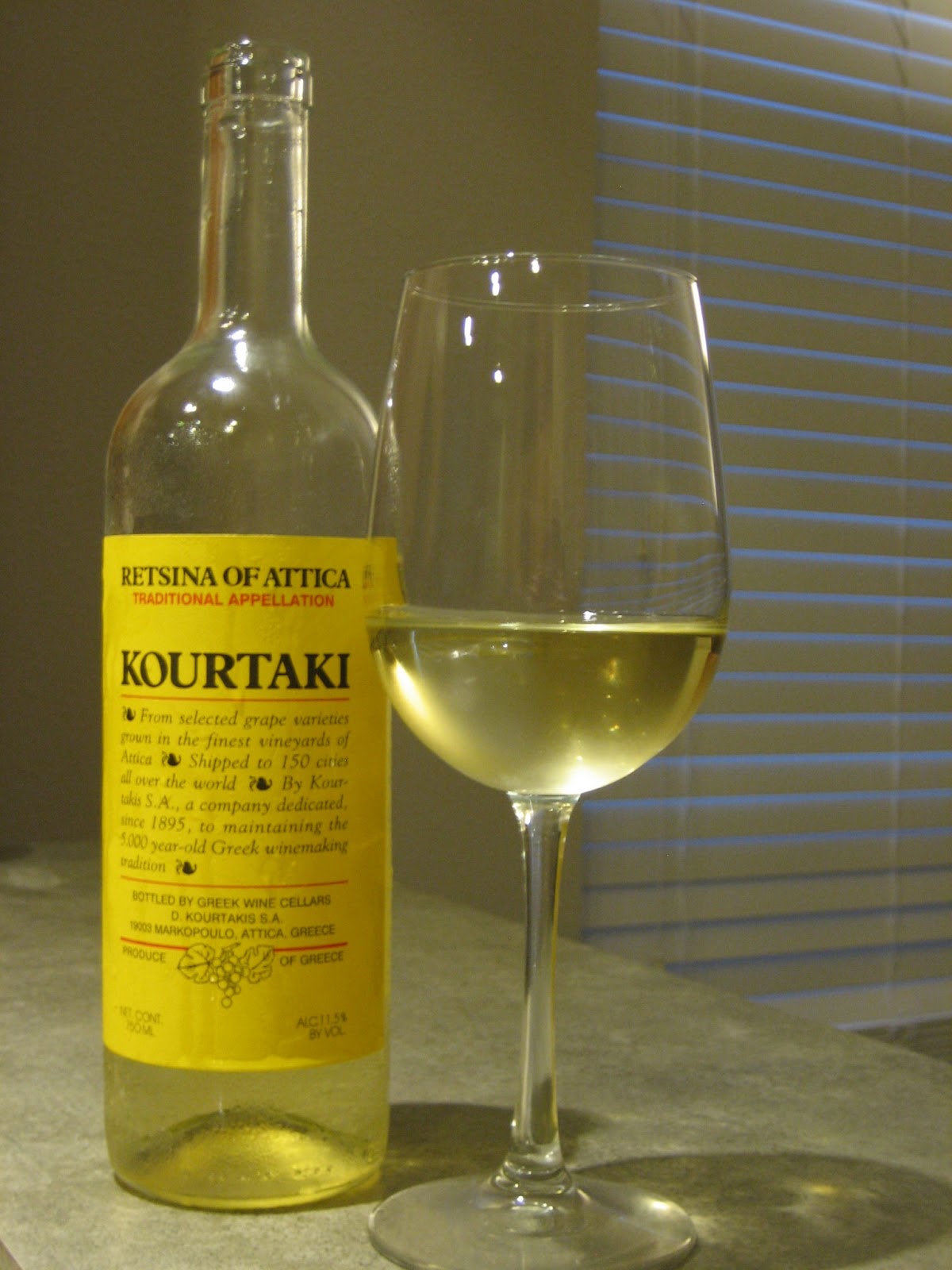
Wine infused with pine resin has been made in Greece for
2000 years and is still made today. It’s called retsina, and you can buy it at
Spec’s for around $7. I bought a bottle of Kourtaki
Retsina of Attica at the Spec’s on Bay Area.
The wine is pale yellow with aromas of citrus and a sharp herbal and
mineral quality, which I assume comes from the pine. The smell is not the sweet pine aroma of a
Christmas candle, but more of a fresh outdoorsy pine. The wine is dry, with medium-high acid, and tastes
like a crisp, simple white wine with a strong herbal flavor. I’d never tasted pine before, but I’d
compare the flavor to rosemary. I’d
recommend drinking this more for the experience than for the quality or taste
of the wine, but that's okay with me when it's only $7. Retsina might have potential as a cooking wine...
Early beer combined elements of beer, wine, and mead.
McGovern has also discovered some fascinating information
about ancient beer. He analyzed the
residue inside of an amphora from Turkey, which was excavated from what is
thought to be the palace of King Midas.
The amphora contained remnants of a fermented beverage made from barley,
honey, and grapes – the basic ingredients of beer, wine, and mead, all in
one. Microbrewers participated in a
contest to recreate what this beverage would have tasted like. Dogfish Head Brewery won the contest and began
producing “Midas Touch.”
Midas Touch is widely available in Houston – from Spec’s to
Whole Foods. It’s pricey at $10 - $14
for a 4-pack of 12-oz bottles, but I think it’s worth it for the chance to try something so unusual. The label
calls it “handcrafted ancient ale with barley, honey, white muscat grapes, and
saffron.” Midas is a light amber color –
darker than a pale ale but lighter than an amber. It tastes like a strong ale – sort of like a Belgian
tripel – with fruit and honey notes, though it isn’t sweet. Its flavors are complex and rich, and its
high alcohol content (9%) contributes to a full-bodied and weighty feel. It’s pretty good, but I wouldn’t make it a
regular drink. Even so, I love that something like this exists. It's a history lesson in a bottle.
Sunday, June 2, 2013
Interesting Odds and Ends
}} I've recently discovered LocalWineEvents.com, a website which will keep you informed about wine events in your area. It requires a free membership and offers additional services for a small fee.
}} Speaking of drinking wine locally, do you enjoy leisurely browsing the grocery store aisles like I do? Wouldn't it be even nicer if you had a glass of wine in your hand? If you shop at the Central Market at Westheimer and Weslayan or the Whole Foods Market at West Alabama and Kirby, you're in luck!
Though it isn't advertised, the coffee bar at the front of Central Market also sells wine by the glass, which you're welcome to consume as you shop. They currently offer a Chardonnay, a Malbec (1919), and a Cabernet. If you're more into beer, you can select one from the single-serve beverages near the salad/soup bar, and as long as you take it to the coffee bar to be opened, you may consume it on the premises.
At Whole Foods, head to the coffee/beer/wine counter near the bakery. They do a better job of advertising what they have to offer, and usually have good selection of rotating wines and beers on draft.
Do you know of other stores in Houston that offer this? Please share in the comments!
}} I came across a neat blog this week. Kris at blogyourwine.com creates and posts some fun infographics and other "wine memes." I encourage you to check out his site.
}} Mira Winery in California recently conducted an experiment with aging bottles of wine in the ocean. When compared to the exact same wine aged in the usual way on land, the wine aged in the ocean tasted different! Studies are underway to determine the exact causes (increased pressure? presence of saltwater? lack of oxygen? lack of light? temperature difference?).
Wine really does get better with age and a little saltwater (Fox News)
Ocean-aged wine is 'more complex' says Napa winery (Decanter)
}} Jennifer Simonetti-Bryan, MW, is producing a video series for greatwinenews.com on aspects of wine quality. Two have been released so far. It looks like there will be about 10 videos total, when the series is complete. I'm excited to see the rest of these, because I think they will answer a lot of questions that people have about how to judge wine, and the end of the "Finesse" video suggests there will be some fun, interactive experiments coming up! (You may recall she is also the author of The One-Minute Wine Master, which I recently reviewed.)
The first video introduces the series and lists specific aspects of wine quality - FBLICCAT!
The second video discusses the first aspect of wine quality, finesse.
Wednesday, May 29, 2013
The Pocket Index of French Wine is 44% off!
My reference guide to French appellations, The Pocket Index of French Wine, is on sale at Amazon! It's usually $7.25, but on sale for $4.08 for a limited time! And it does count toward Super Saver Shipping.
Subscribe to:
Posts (Atom)


